Understanding Modern Communication Preferences
Your phone rings.
You look at the screen… and ignore the call. A few seconds later, you reply with a text message instead.
This behavior has become increasingly common in modern communication. Texting now offers flexibility, emotional comfort, and control, while phone calls can sometimes feel intrusive or stressful. Communication is no longer only about technology; it is increasingly shaped by emotions, convenience, and digital habits.
This project explores how communication behavior is evolving across generations through data visualization and behavioral analysis.
Data Collection and Methodology
To investigate these communication habits, a Google Forms survey was distributed online and collected 219 anonymous responses over a two-week period.
The survey focused on:
- Communication preferences
- Call avoidance behavior
- Reasons for avoiding phone calls
- Text reply speed
- Satisfaction with texting and calling
- Age group differences
The responses were exported to Excel, cleaned using Python and Pandas, and visualized using Matplotlib, Seaborn, and Plotly.
The Shift Toward Text-Based Communication
Figure 1 — Communication Preferences
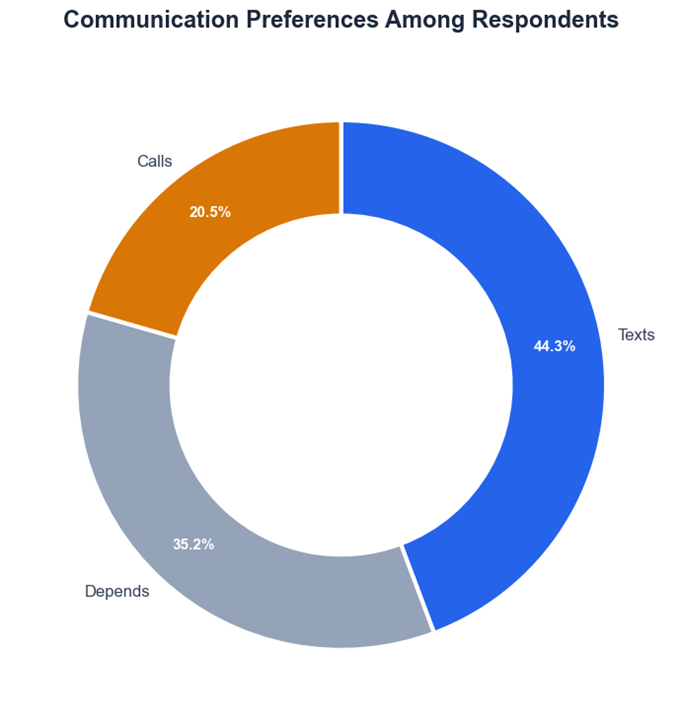
The first visualization immediately reveals a strong pattern: texting dominates modern interaction.
Approximately 44% of respondents preferred texting, while a smaller percentage preferred calls. Many participants also selected “depends,” suggesting that communication choices are increasingly situational and selective rather than fixed.
Texting appears attractive because it gives users more control over when and how they respond. Unlike calls, text messages do not require immediate emotional engagement.
Selective Call Avoidance
Figure 2 — Frequency of Ignored Calls
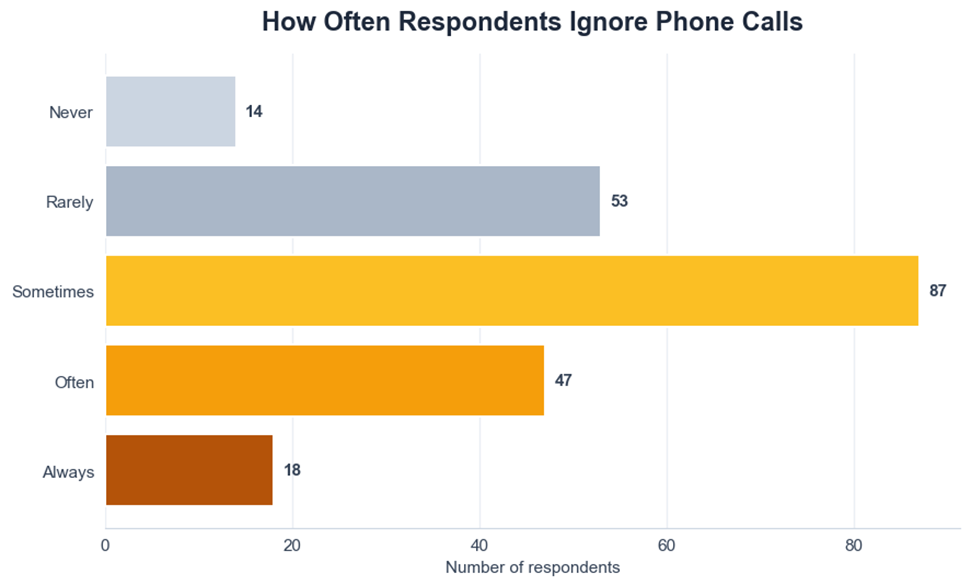
The second visualization shows that most respondents do not completely reject phone calls. Instead, calls are selectively ignored depending on timing, mood, or context.
The most common response was “sometimes,” followed by “rarely” and “often.” Very few participants reported never ignoring calls.
This suggests that modern communication behavior is becoming more filtered and intentional rather than completely avoidant.
Why Do People Ignore Calls?
Figure 3 — Reasons Linked to Call Avoidance
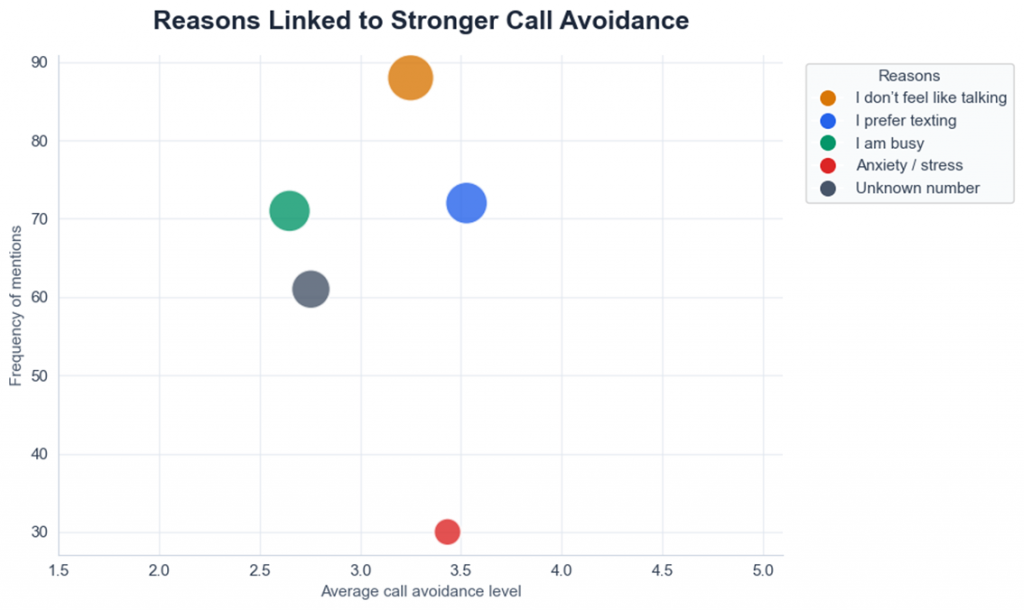
The bubble visualization highlights the emotional and practical motivations behind call avoidance.
The strongest reason was emotional disengagement: many respondents simply reported that they “did not feel like talking.” Other important reasons included:
- preferring texting,
- being busy,
- avoiding unknown numbers,
- and anxiety or stress.
The visualization reveals that emotional comfort plays a central role in communication behavior. Calls require immediate interaction, while texting provides distance, flexibility, and emotional control.
Communication Habits Across Generations
Figure 4 — Communication Preferences Across Age Groups
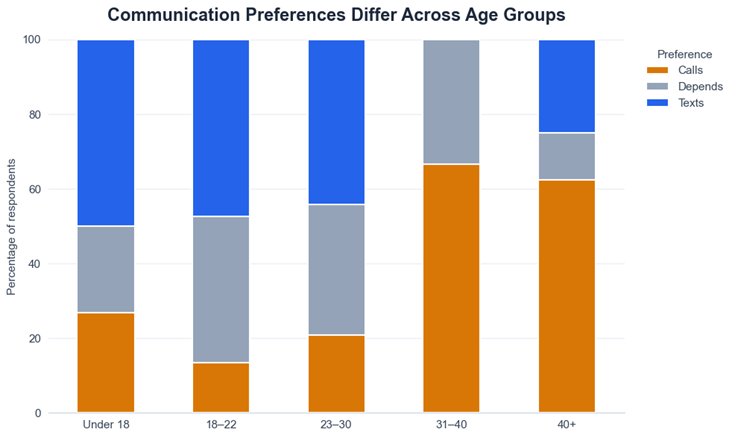
Figure 5 — Text Reply Speed by Age Group
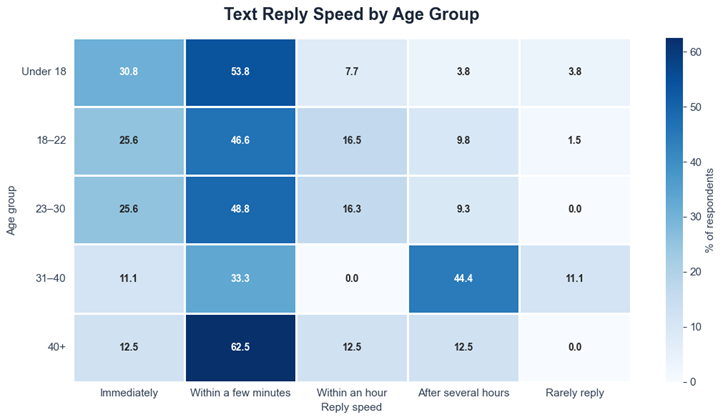
Age also influenced communication patterns.
Younger respondents showed a stronger preference for texting and generally replied faster to messages. Many younger participants responded within a few minutes, reflecting a communication culture built around immediacy and digital interaction.
Older respondents relied more on phone calls, suggesting that communication habits evolve with age, experience, and comfort with technology.
These generational differences demonstrate how digital communication continues to reshape social interaction.
Communication Satisfaction
Figure 6 — Satisfaction Levels: Texting vs Calling
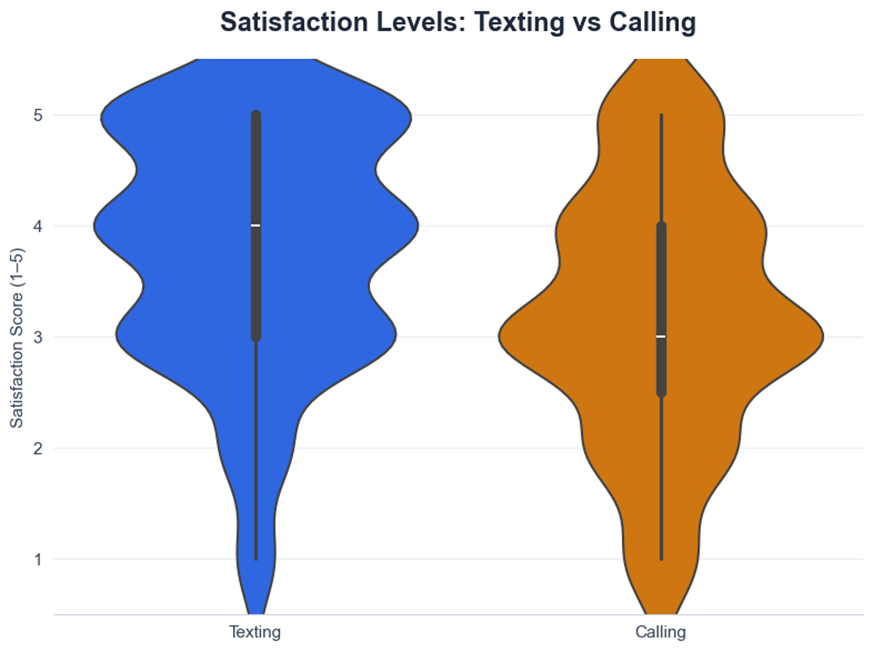
Satisfaction levels revealed another important insight.
Texting produced more consistent positive experiences than calling. In contrast, phone calls generated more mixed emotional responses.
This suggests that emotional comfort strongly influences communication preferences. Texting allows users to respond at their own pace, making interactions feel less demanding or stressful.
Understanding the Full Communication Flow
Figure 7 — Communication Behavior Flow
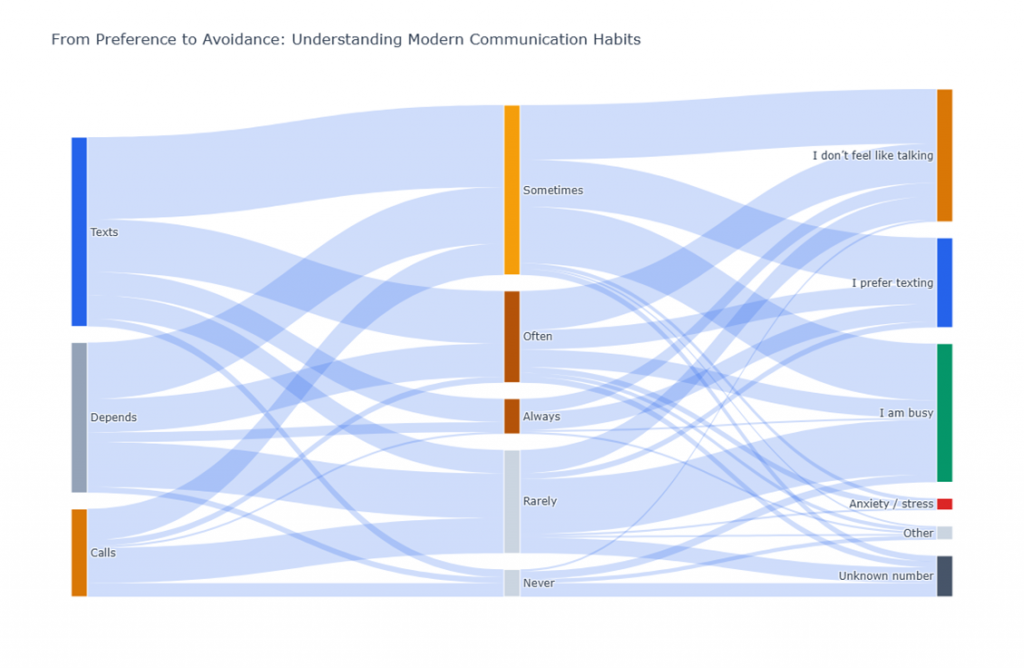
The final visualization connects the entire communication journey together.
People who preferred texting were more likely to selectively avoid calls, often for emotional or practical reasons. The Sankey diagram demonstrates how communication preference, avoidance behavior, and emotional motivations are interconnected.
Modern communication is increasingly shaped by:
flexibility, emotional comfort, and personal control.
Conclusion
So why are people becoming less comfortable with phone calls?
The answer appears closely linked to emotional comfort and digital habits. Texting dominates because it allows people to communicate with greater flexibility and control, while calls require immediate emotional availability.
Rather than rejecting calls completely, people now filter communication depending on context, mood, and emotional energy.
Modern communication is no longer only about technology. It is increasingly about emotional control, convenience, and selective interaction.
Final Reflection
As digital communication continues to evolve, one important question remains:
Will future generations eventually see phone calls as uncomfortable or even unnecessary?
