A Data Visualization Story About Mood, Productivity, and Digital Behavior
Disclaimer: The dataset used in this project was generated using Python for educational and storytelling purposes.
As daylight slowly disappears and screens begin to dominate the night, human behavior often starts to shift in subtle but meaningful ways. Productivity weakens, stress increases, and digital habits become more intense after dark. These behavioral changes may seem ordinary in modern life, yet they raise an important question: do we become different versions of ourselves at night?
This project explores that question through data visualization and behavioral storytelling. Using a generated dataset containing 650 behavioral records collected across different moments of the day, the analysis investigates how mood, productivity, stress, impulsivity, and screen exposure evolve from morning to night.
Rather than focusing only on numbers, the project aims to visualize the emotional rhythm hidden behind digital behavior. Through storytelling-based visualizations, the data gradually reveals how nighttime environments may influence emotional balance, behavioral stability, and digital dependency.
The dataset included several behavioral variables such as productivity scores, mood levels, stress levels, screen time, social media usage, impulsivity, and sleep duration. In addition, a custom metric called the Self-Divergence Score was created to estimate how much behavior changes between daytime and nighttime periods. This score combined stress, impulsivity, screen exposure, and emotional variation into a single indicator representing behavioral imbalance.
From Data to Behavioral Storytelling
Before building the visualizations, the behavioral structure inside the dataset was simplified into two broader states: daytime behavior and nighttime behavior.
During the day, the data generally reflected stronger focus, higher productivity, and more stable emotional patterns. Morning and afternoon records were associated with healthier behavioral balance and lower impulsive activity.
As the day progressed toward evening and night, however, the behavioral pattern began to change. Screen time increased, stress levels became stronger, and impulsive digital behavior appeared more frequently. Instead of remaining stable, behavioral patterns gradually shifted throughout the day.
The goal of the visualizations was therefore not simply to display statistics, but to transform behavioral data into a connected emotional narrative. Each chart reveals a different layer of how nighttime digital behavior may reshape emotional experiences after dark.
Self-Divergence Rises at Night
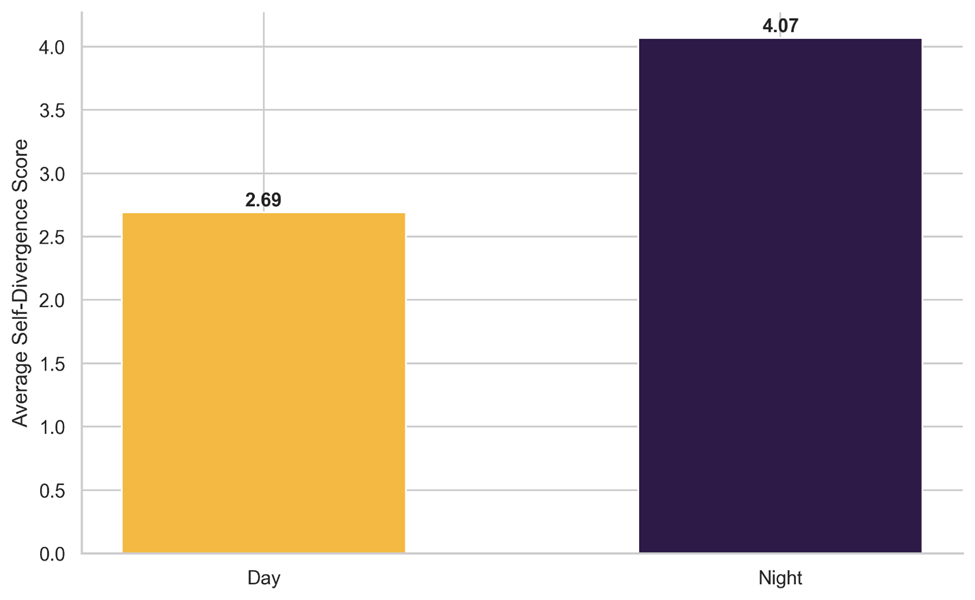
The first major pattern appeared through the self-divergence visualization. Compared to daytime records, nighttime records showed noticeably higher self-divergence scores.
This suggests that behavioral balance becomes weaker during nighttime periods. Stress, screen exposure, and impulsive habits begin to dominate more strongly after dark, creating a wider emotional gap between daytime and nighttime behavior.
During the day, behavior appears more organized and emotionally stable. At night, however, the data begins to reflect fragmentation. Productivity decreases while digital habits become more dominant, suggesting that nighttime environments may encourage less balanced behavioral patterns.
The increase in self-divergence does not necessarily mean that people become entirely different individuals at night. Instead, it suggests that nighttime conditions may amplify emotional instability and reduce behavioral control.
Behavior Changes Gradually Across the Day
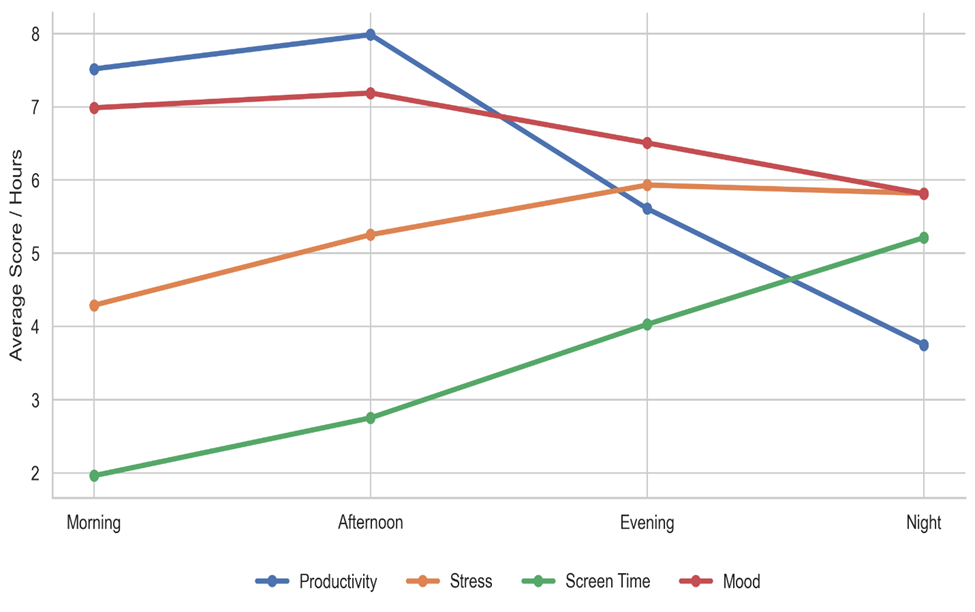
The second visualization revealed that behavioral transformation is not sudden. Instead, it develops gradually throughout the day.
Morning and afternoon records showed the highest productivity and mood levels. These periods reflected stronger focus, better emotional stability, and lower digital dependency. However, as the day moved toward evening and night, the behavioral pattern slowly changed.
Stress levels began increasing while productivity started declining. At the same time, screen time became more dominant. This gradual transition suggests that nighttime behavior is not isolated from the rest of the day, but rather the result of accumulated emotional fatigue and increasing digital exposure.
The visualization also highlights an important emotional contrast. While daytime behavior is associated with structure and activity, nighttime behavior becomes more digitally driven and emotionally reactive.
This transformation reflects a modern behavioral rhythm in which digital environments increasingly shape emotional experiences during late hours.
What Changes the Most After Dark?
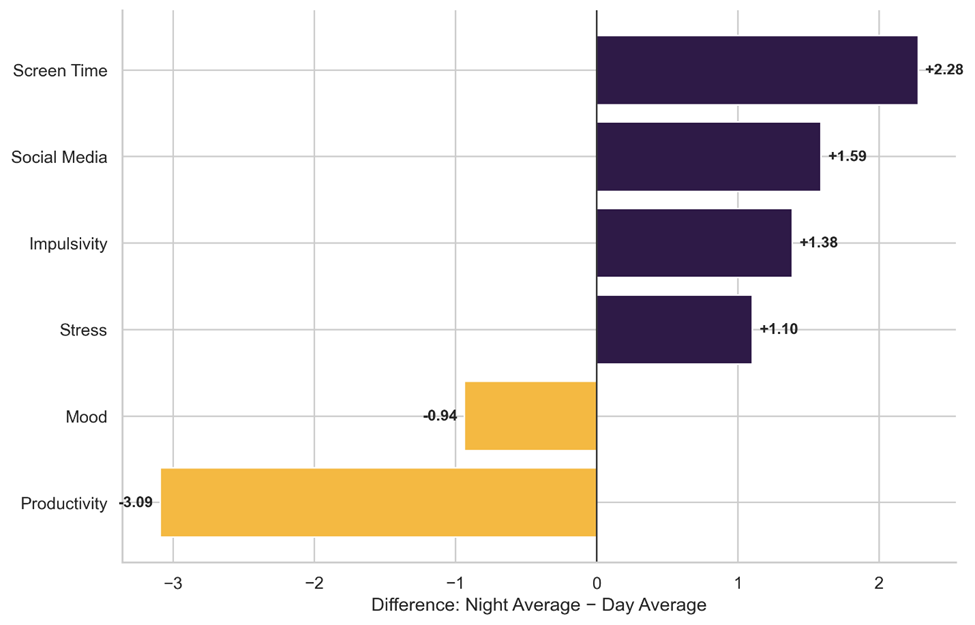
Among all behavioral variables, screen time showed the strongest increase at night.
The visualization demonstrates that digital exposure rises dramatically after dark, followed by social media use and impulsive behavior. Productivity, on the other hand, experiences one of the sharpest declines.
This pattern is particularly important because it reveals that nighttime behavior is not changing randomly. Instead, specific behaviors become consistently stronger during late hours, especially behaviors connected to digital interaction.
The rise in social media use also suggests that nighttime digital behavior may become more emotionally immersive. As individuals spend more time online, emotional pressure and impulsive engagement appear to increase simultaneously.
Meanwhile, lower productivity levels suggest that nighttime digital habits may interfere with concentration, motivation, and behavioral stability.
The contrast between increasing digital activity and decreasing productivity forms one of the central tensions of the entire project.
Screen Time and Stress Begin to Move Together
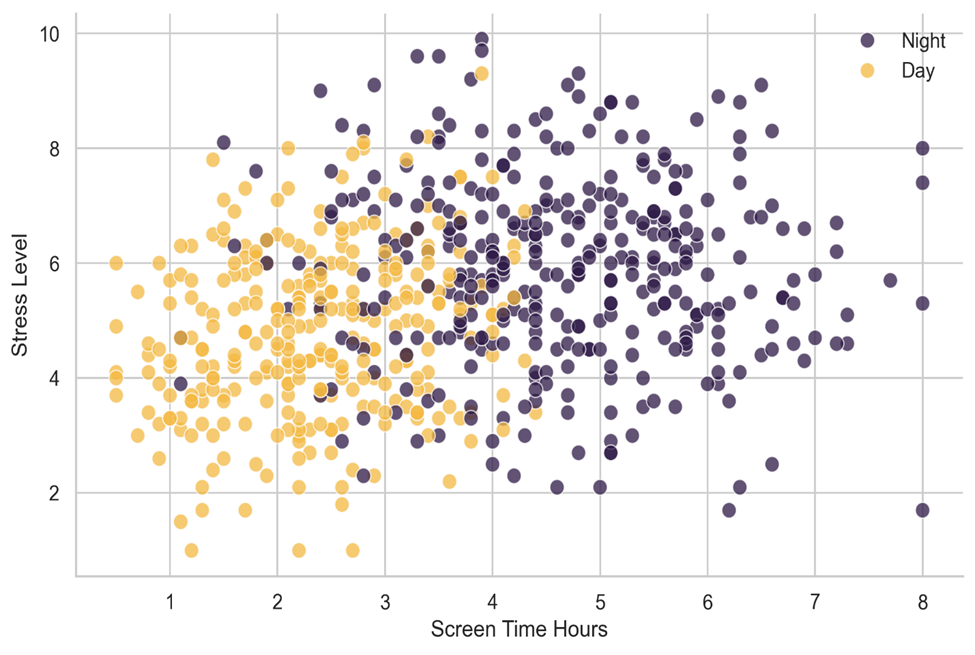
One of the clearest relationships inside the dataset appeared between screen time and stress levels.
The scatterplot shows that as screen time increases, stress levels also tend to increase. Most nighttime records appear concentrated in the upper-right area of the visualization, where both stress and screen exposure are high.
This pattern suggests that extended digital exposure may contribute to emotional pressure during nighttime periods.
Although the visualization does not prove direct causation, the relationship remains significant. The clustering of nighttime records around high stress and high screen time creates a strong visual indication that digital behavior and emotional instability may be interconnected.
The darker nighttime points dominating the upper range of the chart reinforce the broader narrative of the project: nighttime digital environments appear closely associated with rising emotional pressure.
As screens occupy more time during late hours, emotional balance may become increasingly difficult to maintain.
The Hidden Behavioral Network
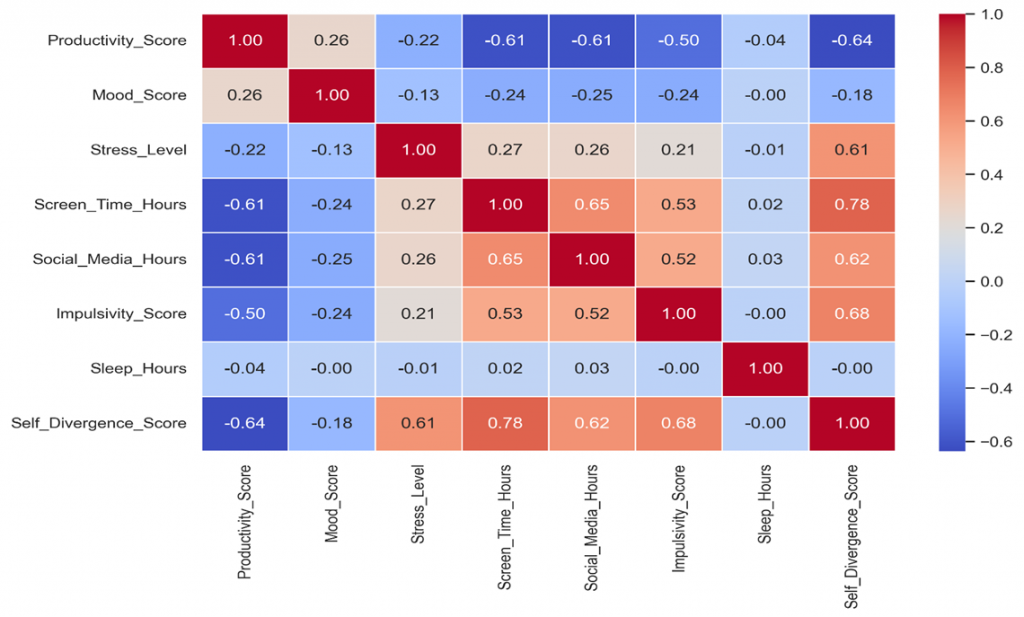
The final visualization connects all behavioral variables together through correlation analysis.
The heatmap reveals strong positive relationships between screen time, social media usage, impulsivity, stress, and self-divergence. These variables appear interconnected rather than isolated.
At the same time, productivity shows an opposite relationship. As stress and digital exposure increase, productivity gradually decreases.
This visualization is important because it transforms the project from a collection of individual charts into a complete behavioral system.
Nighttime digital behavior does not simply influence one variable. Instead, it appears connected to a broader network of emotional and behavioral changes. Stress, impulsivity, emotional instability, and digital habits begin reinforcing one another simultaneously.
The heatmap ultimately suggests that nighttime behavioral transformation may be part of a larger emotional ecosystem shaped by digital exposure.
Conclusion: So, Do We Become Different Selves at Night?
After combining all the visualizations together, a clear nighttime behavioral pattern begins to emerge.
As the day progresses toward night, productivity gradually weakens while stress, screen time, impulsive behavior, and self-divergence become increasingly dominant. Across the charts, nighttime records consistently reflect stronger digital dependency and lower behavioral stability.
What makes this transformation particularly important is that it extends beyond simple screen usage. The visualizations collectively point toward a broader shift in emotional balance and behavioral identity.
Nighttime digital behavior may slowly reshape the way individuals think, feel, react, and engage with their environment. The issue is therefore no longer only about technology itself, but about how digital environments may influence emotional experiences during the most vulnerable hours of the day.
Perhaps we do not become completely different people at night.
But the data suggests that after dark, parts of ourselves begin to behave differently.
